Bioethanol France,
a professional trade association.

Bioethanol France is the professional trade association representing the interests of French producers of agricultural alcohol (fuel bioethanol and traditional alcohol). The association promotes innovation and collaboration with agricultural, energy, and end-use industry stakeholders to support the transition toward a more sustainable economy and mobility.

> Areas of action.

Promotion, information, studies, action plans, and representation.

> The team

Presentation of the trade association’s operational team.

> Members

French producers of agricultural alcohol.

Agricultural alcohol,
a resource derived from plants.

Agricultural alcohol is derived from renewable plant-based resources, and plays a key role in the circular economy. Il combine performances économiques et respect de l’environnement tout en répondant aux besoins d’un marché mondial en constante évolution.

> A sector of excellence.

Harnessing the synergy of plants

> Raw materials

A wide variety of agricultural raw materials.

> The processes

Stages of bioethanol production.

> The main outlets

Applications across many sectors.

> Co-products

Optimal valorization of raw materials.

Bioethanol, the world's most widely used biofuel

Bioethanol is a biofuel intended for gasoline engines. It is the most widely used biofuel in the world. It replaces part of the fossil fuel in gasoline-type fuels. It significantly reduces greenhouse gas emissions and decreases dependence on oil.

> A fuel by essence

Bioethanol, the most widely used biofuel in the world

> Challenges and assets

Reducing CO₂ emissions

> SP95-E10

France's No. 1 gasoline

> Superethanol-E85

The fuel of purchasing power and respect for the environment

> ED95

A fuel designed especially for buses and coaches

Synergies with Future Energies

By harnessing the synergies between plant-based resources and new energy technologies, bioethanol is emerging as a key link in the energy transition. It helps build a more sustainable mobility model for future generations.

> A fuel for the future.

More sustainable mobility.

> The future: 100% renewable E85.

An eco-friendly alternative to traditional fuels

> Our CSR commitment.

Promoting a more sustainable energy model.

> Sustainable aviation fuel.

Replacing fossil kerosene in aviation.

> Marine fuel

Bioethanol in maritime transport.

Latest news and publications.

In this section, you will find all the essential resources to follow our latest news and access our official publications.

> All the news

The timeline of our actions.

> Press area

Resources available to the media.

> Key figures

Monthly data on SP95-E10 and Superethanol E85.

> Technical documents

Available as open source.

LE BIOETHANOL,

FUEL OF THE FUTURE

Synergies with Future Energies

Bioethanol is part of a broader ecosystem of complementary renewable energies. Bioethanol fits perfectly into this dynamic by complementing and strengthening other sustainable solutions.

By harnessing the synergies between plant-based resources and new energy technologies, bioethanol is emerging as a key link in the energy transition. Accessible, efficient, and environmentally friendly, it helps build a more sustainable mobility model for future generations.

1. Electricity & bioethanol: a high-performance alliance

Plug-in hybrid vehicles (PHEVs) running on Superethanol-E85 combine the best of both worlds: electric power for short trips and bioethanol for long distances.

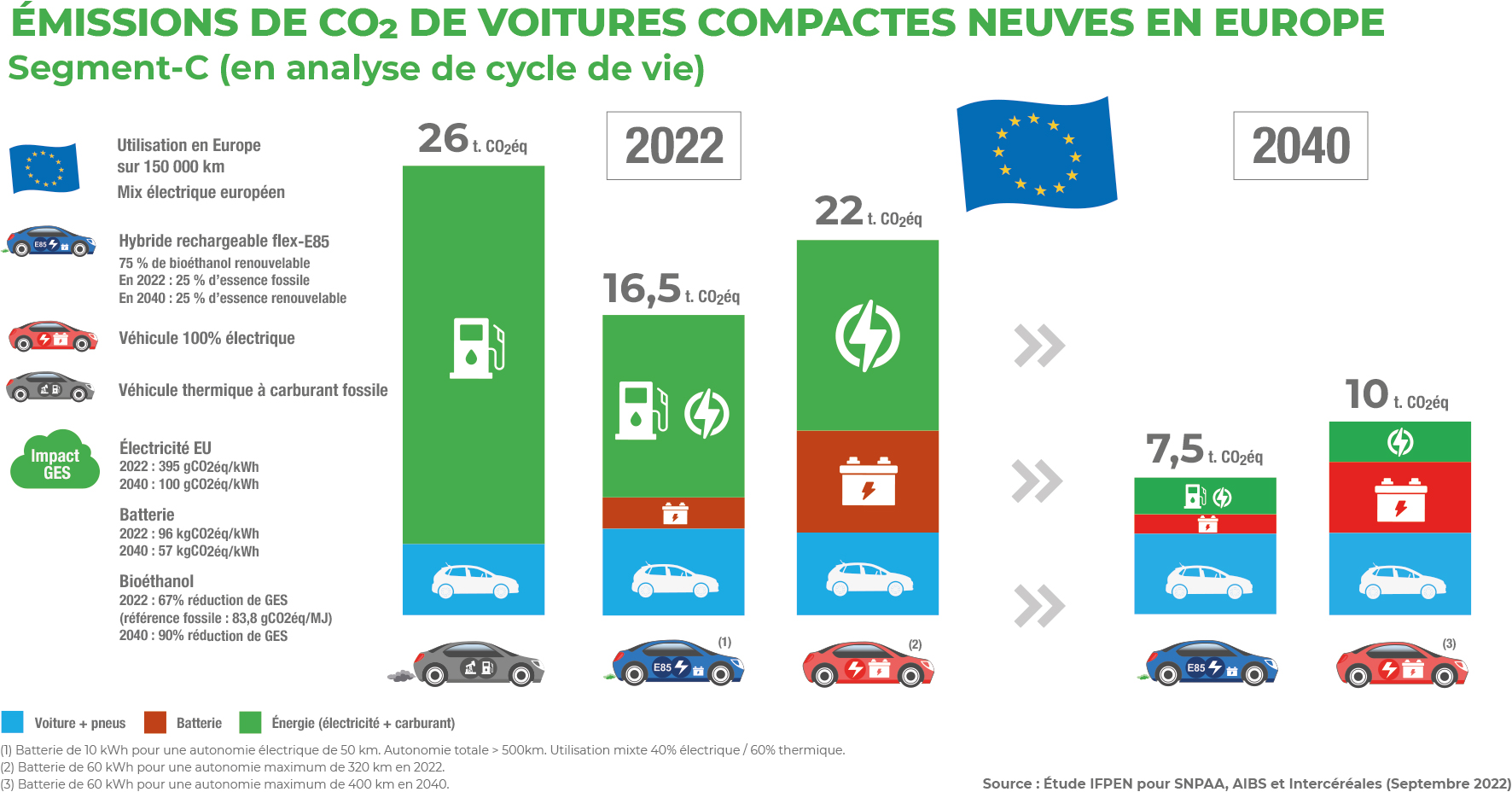
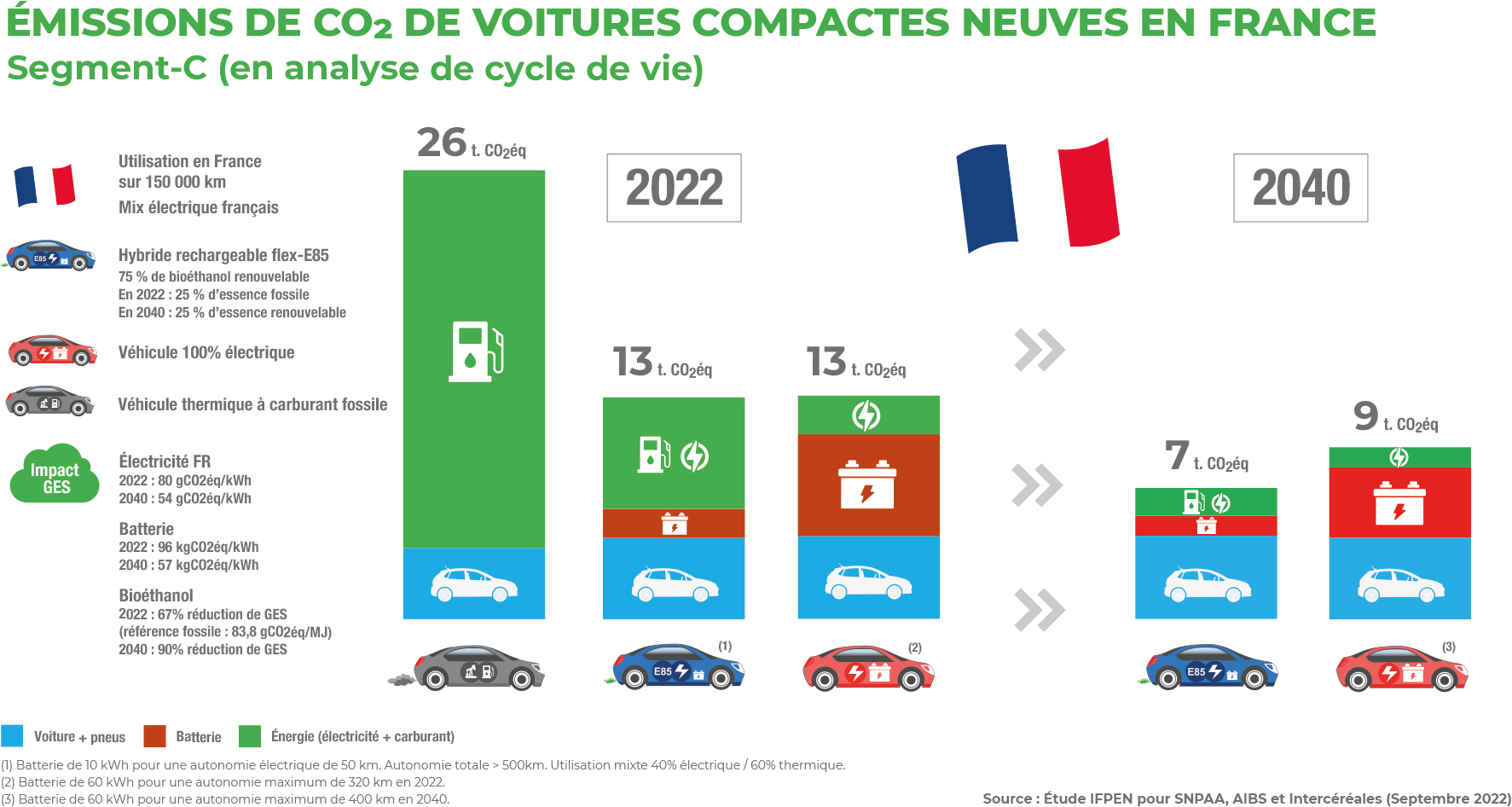
A 2022 IFPEN study showed that for a C-segment vehicle, an E85 PHEV driving 60% of its mileage in combustion mode is just as climate-friendly as an electric vehicle equipped with a 60 kWh battery when using the French electricity mix.

At the European level, the E85 PHEV is even better for the climate due to the higher carbon intensity of the European electricity mix.

2. Biogenic CO₂: a primary resource for sustainable aviation fuels (SAF)

Bioethanol production inherently generates biogenic CO₂. This easily capturable biogenic CO₂ will be one of the primary resources—together with hydrogen produced by water electrolysis—for the production of SAF.

3. Bioethanol and SAF co-products: a strategic complementarity

During the production of SAF, co-products similar to gasoline and diesel are necessarily generated. These gasoline-type co-products cannot operate properly on their own in a gasoline engine because they do not meet the required specifications (they have an octane rating of around 40, whereas the engine requires a minimum octane rating of 95).

By blending these co-products with at least 50% bioethanol, the resulting mixture reaches an octane rating above 95, enabling proper combustion in an engine.